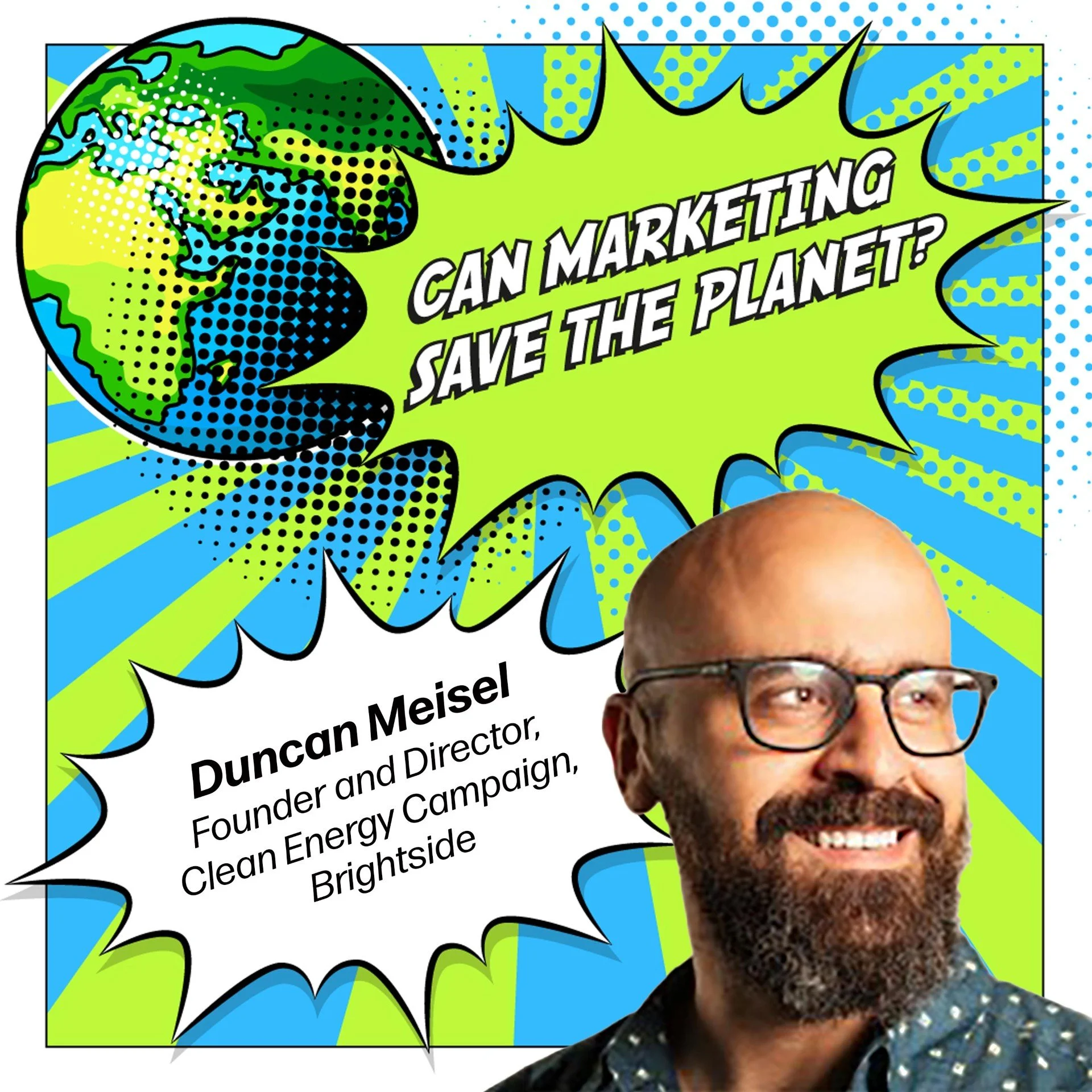
In this episode of Can Marketing Save the Planet, we are joined for the third time by Duncan Meisel, previously known for founding Clean Creatives. Duncan returns to this episode to discuss his new venture, Brightside, a campaign focused on building the clean energy economy by shifting culture, politics, and public perception.
Duncan's background is in running campaigns for climate NGOs. He spent time working on stopping pipelines, starting the fossil fuel divestment movement, and helping secure the Paris Climate Agreement. Much of that work, he explains, was in the "saying no" realm, “which we need to keep doing because those people are dangerous and bad and doing the wrong thing and trying to destroy the planet." But with Brightside, he's shifting the focus to an area that has a huge amount of opportunity surrounding it, the clean energy economy.
The timing is crucial. Solar, wind, and batteries are being deployed at unprecedented speed, changing the energy economy. But the clean energy industry, Duncan argues, has not done an effective enough job advocating for itself. "We need to shift the culture within that industry, shift the culture within our politics to see clean energy as a really vital part of the economy and not just an alternative energy source."
A core concept driving Brightside is social proof. The climate movement has millions of people willing to spend their volunteer hours marching, building, advocating. "People respond to other people, that social proof is sort of an unlock to a lot of change." Yet when people think of clean energy, they don't have an image of who benefits. "When we support climate action, we don't know who's being impacted. It's not that storytelling intuition. It's not that image of who benefits."
Brightside is experimenting with new forms of advocacy for 2026. Duncan admits he's been in front of the camera far more than ever before, and the campaign is leaning into humour and social video. "We're trying to be more approachable, funnier. We like telling jokes." He explains, "It's not something I would have thought to do when I was trying to build the People's Climate March in 2014."
Duncan thinks of comedy writing as a conceptual framework for all communication, "You don't always need to be telling jokes, but you do need to be writing good setups. You need to be writing things that capture people's attention immediately. The first three seconds of whatever content you're creating are some of the most important." In the attention economy, climate content isn't just competing with other political issues, it's competing with lifestyle influencers, sports highlights, and the meme of the day.
Another guiding concept is pluralistic ignorance which is the gap between public opinion and what people think public opinion is. "80 to 90% of people think clean energy is a great idea, but when you ask people what percentage of people support this, they tend to report about 20 points lower." The perception is far more polarised than the reality.”
Tune in as we talk to Duncan about:
Why Brightside is shifting from saying no to fossil fuels to building the clean energy economy, and why the industry needs to advocate for itself.
The power of social proof, and how to make passionate supporters visible.
Competing in the attention economy.
Pluralistic ignorance: why the vast majority support clean energy but think they're in the minority.
Duncan invites you to get in touch to ask questions and continue the conversation - connect on LinkedIn https://www.linkedin.com/in/duncan-meisel-8aa904158/
And for more information about the Brightside movement - see here https://www.brightside.now/
Enjoy…
With love
Michelle & Gemma
________________________________________________________________________
About us…
We help Marketers save the planet. 🌍
Join the Marketers and organisations who have signed our manifesto, engage with our newsletter and training and, work with us to communicate sustainability more effectively. Sign our Sustainable Marketer Manifesto, and join us on our mission. Get in touch to chat.
You’ll find the Podcast on all the usual pod platforms - and also on The Global Player. If you love it, do share it and spread the word. Talking about climate change and the role we play is one of the most important things we can do. So join the conversation. We’re all in this together.
Our podcasts are recorded purely via online conferencing platforms, we apologise for any minor sound quality issues.